

This article is for informational purposes only and does not constitute financial or investment advice. Always consult a qualified real estate or financial professional before making any investment decisions.
The commercial real estate market in 2026 is not moving in one direction. It is moving in several directions at once — and the investors who treat it as a single, unified story are going to miss both the risks and the opportunities hiding inside the complexity.
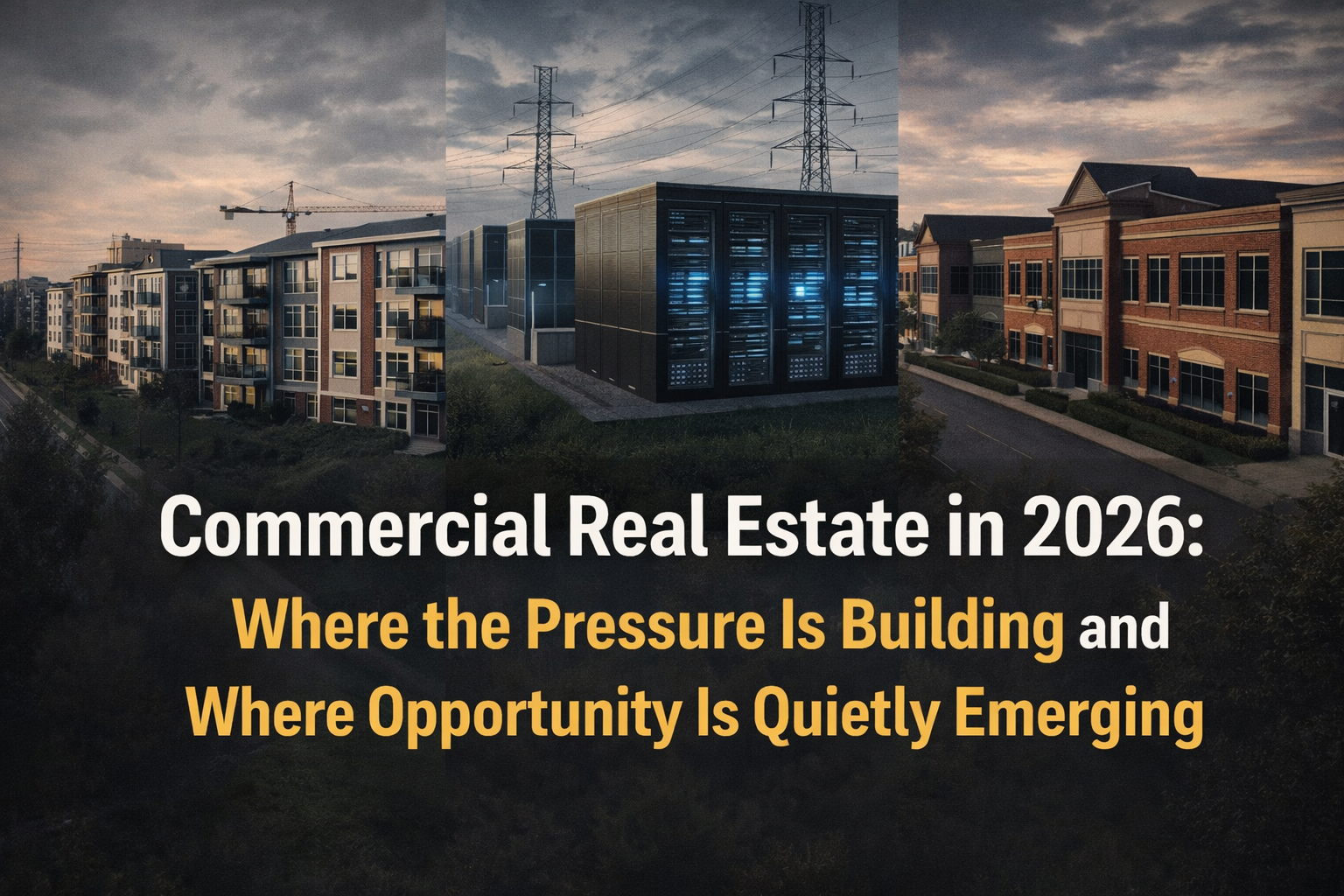
Multifamily, long the darling of institutional capital, is now dealing with a supply hangover that is pushing vacancy higher and rent growth toward zero in markets that were considered bulletproof just two years ago. Data centers are experiencing one of the strongest demand surges in modern real estate history, fueled by artificial intelligence infrastructure buildout — but that demand is running directly into a power grid that was not built for this moment. Capital markets are healing, but beneath the improved sentiment sits a refinancing wall that will force difficult decisions for a significant portion of CRE borrowers before the decade is out. And suburban office — universally dismissed, broadly repriced, and almost entirely avoided by institutional capital — may contain more selective opportunity than the headlines have suggested.
This is what the 2026 commercial real estate landscape actually looks like. Not a recovery. Not a collapse. A fragmentation — into winners, laggards, and deeply misunderstood niches.
Multifamily Is No Longer a Simple Growth Story
For most of the past decade, multifamily was the closest thing commercial real estate had to a consensus trade. Strong demographic tailwinds, chronic undersupply relative to household formation, and rent growth that outpaced inflation made apartments the preferred asset class for institutional and private capital alike. That narrative is not entirely wrong. But in 2026, it requires serious qualification.
According to CBRE data, U.S. multifamily vacancy reached 4.9% in Q4 2025. Net absorption turned negative in Q4 2025 for the first time since Q4 2022 — meaning more units were vacated than leased on a net basis. Average effective rent growth slowed to just 0.2% year over year. Those numbers represent a significant deceleration from the 10 to 15% rent growth that defined 2021 and 2022.
The cause is not demand destruction. It is supply. The construction pipeline that was greenlit during the pandemic boom years has been delivering units at scale, and in the highest-growth Sun Belt markets, that delivery has outpaced absorption. Austin, Phoenix, Denver, Tampa, Nashville, Orlando, Portland, and Salt Lake City are all dealing with elevated vacancy and concession packages — free months of rent, reduced deposits, move-in incentives — that are compressing effective rents even where asking rents appear stable.
The critical nuance here is bifurcation. Not all multifamily is struggling. Gateway markets with constrained supply pipelines continue to see firmer fundamentals. Workforce housing in supply-constrained suburban locations is holding up better than luxury high-rise product in oversupplied urban cores. Class B assets in markets with genuine affordability-driven demand are performing differently than Class A new construction in metros where the development pipeline ran too hot.
What has changed is the investment thesis. For the better part of a decade, owning apartments in a high-growth Sun Belt market was itself a sufficient strategy. Today, market selection, submarket positioning, and asset-level underwriting matter more than the broad sector call. Investors who underwrote multifamily on the assumption that demand always absorbs supply quickly are being forced to recalibrate.
Data Centers Are Becoming One of the Most Powerful Stories in Real Estate
While multifamily works through a supply correction, digital infrastructure is experiencing something close to the opposite problem: demand that is outrunning the ability to build.
The data center sector is being driven by a fundamental shift in computing requirements. Artificial intelligence workloads — training large language models, running inference at scale, supporting cloud-native enterprise applications — require dramatically more computational power than the workloads that defined the data center market a decade ago. Hyperscalers including the largest technology companies in the world are committing capital to digital infrastructure buildout at a pace that has no recent precedent.
JLL projects that the global data center sector will nearly double to 200 gigawatts of capacity by 2030. AI workloads are becoming a significantly larger share of total data center demand, reshaping the technical specifications — power density, cooling requirements, physical footprint — of what the next generation of facilities needs to look like. Preleasing activity has been exceptionally strong, with major tenants committing to capacity years before delivery.
For real estate investors, this creates one of the more compelling long-term demand stories in the asset class. Data centers are not a cyclical story in the traditional sense. They are being driven by a structural shift in the global economy’s computing infrastructure. The capital flowing into digital infrastructure — from sovereign wealth funds, pension funds, private equity platforms, and hyperscalers themselves — reflects a bet that this demand is durable, not transient.
The challenge is not demand. The challenge is something more fundamental.
The Constraint Few Investors Can Ignore: Power
If data center demand is the opportunity, power is the bottleneck — and understanding this constraint is increasingly essential to understanding where the real estate opportunity actually sits.
Gartner has projected that data center electricity demand will roughly double by 2030. Goldman Sachs has estimated that data center power demand could rise between 165% and 175% over the same period. Those are extraordinary numbers for a grid that was not designed with this trajectory in mind.
AI servers are dramatically more power-intensive than the servers they are replacing. The physical density of power consumption in next-generation AI data centers — measured in kilowatts per rack — is multiples of what older facilities were built to handle. This is not simply a real estate problem. It is an infrastructure problem, a grid problem, and in some geographies, a permitting and utility interconnection problem that can add years to project timelines.
The consequence is that site selection for data centers has fundamentally changed. Proximity to fiber, land availability, and tax incentives — the traditional drivers of data center location decisions — now take a back seat to one question: where is the power? Markets with available grid capacity, favorable utility relationships, access to renewable energy, and streamlined interconnection processes are winning deals that would previously have gone to more obvious locations.
This is creating genuine opportunity in secondary and nontraditional markets. States and municipalities with strong energy infrastructure — hydroelectric access in the Pacific Northwest, nuclear-adjacent markets in the Midwest, regions with significant renewable buildout — are emerging as competitive data center destinations. For real estate investors and developers with the patience and technical expertise to navigate the power infrastructure challenge, this is where differentiated positioning is being built.
Capital Markets Are Healing, But the Debt Wall Still Matters
The mood in CRE capital markets has improved meaningfully from the depths of 2023 and early 2024. As the Federal Reserve began cutting rates and financing conditions stabilized, transaction activity picked up. Lenders became more competitive. Bid-ask spreads on assets — the gap between what sellers wanted and what buyers would pay — began to narrow in certain sectors. Deal flow, while still below cycle peaks, showed clear directional improvement through 2025.
For investors and operators who had been sidelined waiting for a more functional transaction market, this represents meaningful progress. Price discovery is improving. Capital is moving. The paralysis that defined 2023 is not the defining characteristic of 2026.
But the debt maturity wall is not a headline to be dismissed.
Approximately $1.26 trillion of commercial real estate debt is set to mature through 2027. Looking further out, more than $2 trillion of CRE debt may mature by 2030. A significant portion of this debt was originated during the low-rate environment of 2019 through 2022 — loans underwritten to NOI assumptions, cap rate assumptions, and debt service coverage ratios that made sense when the 10-year Treasury was near 1.5%. Refinancing those loans into a meaningfully higher rate environment, in some cases with assets whose income has not grown as projected, creates a fundamental math problem.
The likely outcomes are not uniform. Some borrowers will successfully refinance at modestly worse terms and move on. Others will negotiate extensions and modifications, kicking the problem down the road. Some assets — particularly in office, and in multifamily markets where rent growth has stalled — will face more serious distress: recapitalizations, forced sales, or lender-driven resolution.
For opportunistic capital, this is where the pipeline of interesting situations is building. The distress is not arriving all at once. It is arriving gradually, asset by asset, in markets where the fundamentals shifted and the capital structure did not adjust quickly enough. Investors with dry powder, patience, and underwriting discipline will have opportunities to acquire assets at prices that reflect today’s stress rather than yesterday’s optimism.
Why Suburban Office Might Be More Interesting Than the Headlines Suggest
The office sector remains one of the most negatively perceived asset classes in commercial real estate. That perception is not entirely wrong. Downtown office markets in major cities are still dealing with elevated vacancy, reduced leasing velocity, and a conversion and demolition pipeline that reflects the market’s acknowledgment that not all of the existing stock belongs in the future. The headlines on office are genuinely bad in many markets, and they are bad for real reasons.
But the headline and the opportunity are not always the same thing.
Within the broad office category, suburban office is showing signals that deserve more careful attention than the blanket negative narrative allows. Cresa reported positive suburban Class A absorption in Q1 2025. Trepp found improving debt service coverage ratio trends in suburban office assets through 2025. These are not signals of a broad suburban office recovery — they are signals of bifurcation within a sector that the market is still treating as monolithic.
The contrarian case for select suburban office is not that the asset class is healthy. It is that certain assets are being priced as if they are worthless when the underlying fundamentals — tenant quality, lease duration, submarket positioning, capital needs — may tell a more nuanced story.
The assets that warrant attention are specific. Smaller suburban buildings in locations with genuine highway access and employee convenience. Suburban nodes with walkable amenities, nearby retail, and the quality-of-life characteristics that matter to tenants who have relocated away from downtown cores. Buildings with diversified tenant rosters and staggered lease rolls that reduce concentration risk. Assets with physical characteristics that allow for flex, coworking, or medical office conversion components.
The opportunity exists for a straightforward reason: institutional capital has almost entirely abandoned the sector. When a large category of buyers exits a market, pricing often overshoots to the downside. Assets trade at steep discounts to replacement cost. Banks extend and pretend rather than force resolution — which means patient buyers can sometimes acquire assets before forced sale dynamics create outright distress pricing, if they are willing to do the work.
Due diligence matters enormously here. Tenant credit quality, upcoming lease rollover exposure, deferred capital needs, submarket vacancy, and realistic leasing assumptions are the variables that separate a genuine opportunity from a value trap. Suburban office is not a sector to approach with a broad brush in either direction. The negative narrative is too sweeping. The positive case requires asset-by-asset conviction.
What Smart CRE Investors Should Watch for the Rest of 2026
The macro backdrop will continue to shift. Here is where attention should be focused across each major sector.
In multifamily, the metric that matters most is net absorption relative to new deliveries. Markets where the supply pipeline is thinning — where new starts have slowed enough that deliveries will moderate in 2027 and 2028 — are closer to a potential inflection. Watch concession packages as a leading indicator of effective rent pressure. Watch vacancy trends at the submarket level, not just the metro level.
In data centers, the critical variable is power access. Track utility interconnection queues, renewable energy procurement activity by hyperscalers, and permitting timelines in emerging data center markets. Preleasing velocity — how quickly new supply is committed before delivery — remains a strong signal of underlying demand strength.
In capital markets, the refinancing stress will become more visible as maturity dates arrive and extend-and-pretend strategies reach their limits. Monitor CMBS delinquency rates by sector. Watch for increases in special servicing transfer activity, particularly in office and in oversupplied multifamily markets. The distressed deal pipeline is building. It will not arrive all at once.
In office, submarket-level leasing data is more informative than metro-wide statistics. Track which suburban nodes are seeing repeat tenant activity — renewals, expansions, new leases — versus which are seeing progressive roll-down and rising vacancy. Price discipline matters: the assets worth pursuing are those where the basis makes sense under conservative assumptions, not assets priced for a recovery that may not materialize.
Conclusion
The investors who will perform best in commercial real estate over the next several years are unlikely to be those with the strongest macro view. They will be the ones who resist the pull of broad narratives — in either direction — and build conviction at the asset level and the submarket level, where the real story is always being written.
Commercial real estate in 2026 is not a single market. It is a collection of distinct stories, each with its own supply-demand dynamics, capital structure pressures, and opportunity set. Multifamily is sorting itself by market and asset quality. Data centers are racing to solve a power problem that may ultimately shape the geography of digital infrastructure for a generation. Capital markets are healing while a debt wave gathers. Suburban office is being ignored at prices that, in select cases, may not reflect reality.
The old framework — buy the sector, ride the cycle — has limited usefulness in this environment. What replaces it is judgment: the ability to distinguish between headline risk and asset-level reality, between sectors under permanent structural pressure and sectors that are simply misunderstood in this moment.
That distinction, in 2026, is where the work is. And it is where the opportunity is.