

This article is for informational purposes only and does not constitute financial or investment advice. Always consult a qualified real estate professional before making any purchasing decisions.
The U.S. housing market is entering one of the most unusual periods in modern history. Not a crash in the traditional sense — no wave of subprime defaults, no overnight collapse in values — but something arguably more stubborn: a prolonged, grinding freeze driven by an affordability crisis that neither time nor Federal Reserve policy has been able to thaw.
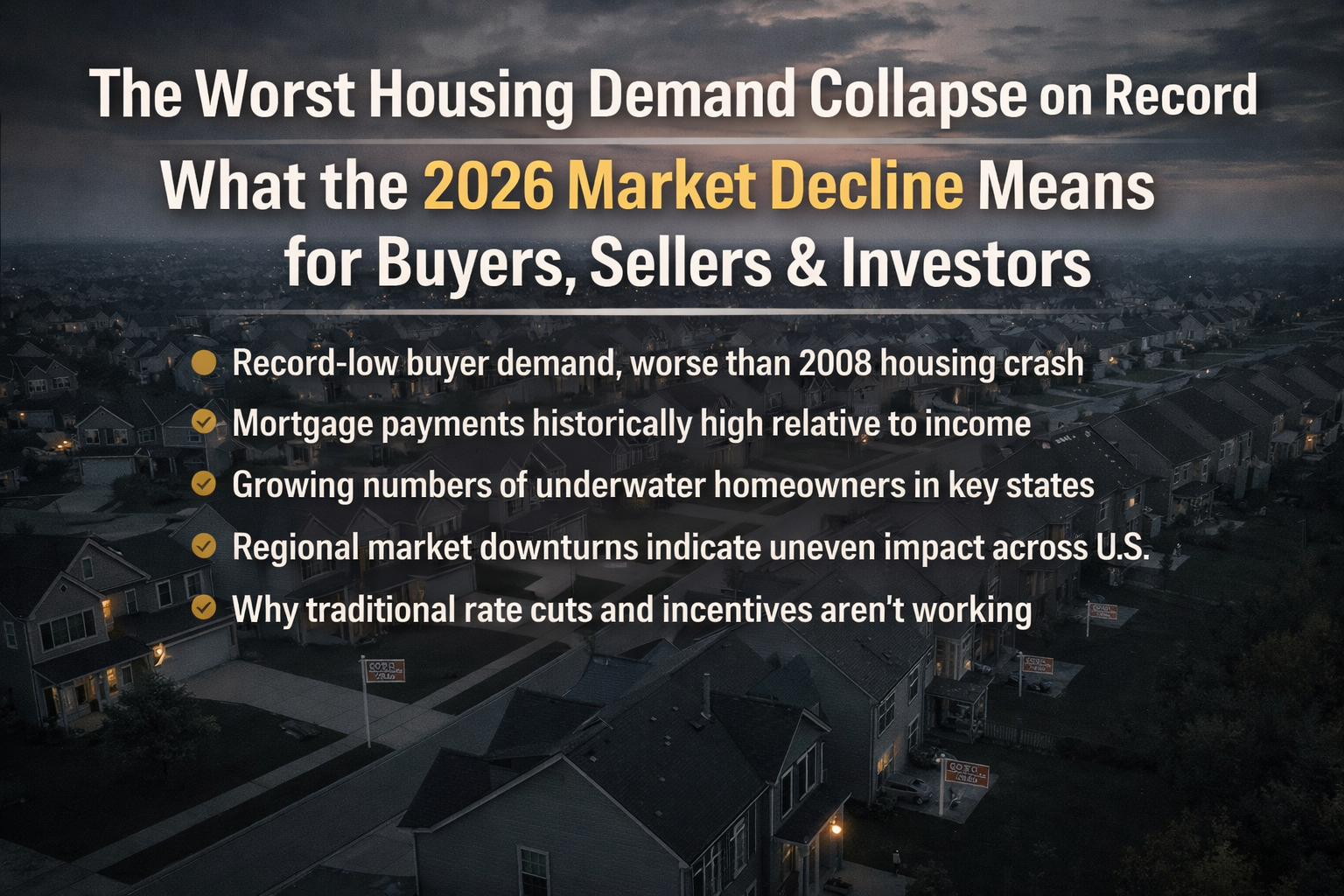
Home buyer demand has now been in decline for multiple years. That duration alone sets this moment apart. Most housing slowdowns are sharp but short. Buyers retreat, prices adjust, rates move, and the market finds equilibrium. What is happening now is different. Demand has stayed weak through rate hikes, through rate cuts, through a pandemic-era boom, and through its unwind. The market is not correcting quickly. It is correcting slowly — and that slow correction carries its own risks.
At the core of this is a straightforward affordability problem. Home prices rose dramatically between 2020 and 2022. Mortgage rates then rose sharply in 2022 and 2023. The result is a monthly payment burden that has pushed homeownership out of reach for a significant portion of the American public. Until that equation changes — through falling prices, falling rates, or rising incomes — demand is unlikely to meaningfully recover. The 2026 housing market is being shaped entirely by that reality.
The Collapse in Home Buyer Demand
The numbers are stark. Home buyer demand in the United States is currently running approximately 42% below its pandemic-era peak. That is not a rounding error or a seasonal adjustment — it is a structural collapse in the pool of active buyers participating in the market.
Mortgage applications, one of the cleanest leading indicators of purchase intent, remain far below pre-pandemic norms. Existing home sales have fallen to levels not seen in decades. In city after city, the same story plays out: homes sit on the market longer, open houses draw fewer visitors, and the urgency that defined the 2020 to 2022 buying frenzy has completely evaporated.
What makes this demand environment historically unusual is its duration. Short-term demand drops are common in housing. A quarter or two of weakness following a rate shock is normal. What is not normal is demand staying this depressed across multiple years, through multiple Federal Reserve policy shifts, without a meaningful recovery. The housing market has effectively been operating in a low-demand environment since mid-2022 — nearly four years — and there is no clear catalyst on the immediate horizon to reverse it.
The Affordability Crisis Driving the Market
To understand why demand has stayed this weak for this long, the math of homeownership needs to be examined directly.
The typical monthly mortgage payment on a median-priced U.S. home currently sits around $2,700. For the median American household, that payment represents approximately 37% of gross monthly income. That figure is not simply uncomfortable — it is historically associated with market stress. For most of the post-war era, housing economists have used 28 to 30% of gross income as the threshold for sustainable mortgage payments. At 37%, a meaningful portion of would-be buyers are simply priced out, regardless of their desire to own.
The affordability crisis is the product of three variables colliding simultaneously. Home prices rose dramatically during the pandemic, in many markets by 40 to 60%. Mortgage rates then climbed from historic lows near 3% to above 7%. And income growth, while real, has not come close to keeping pace with the combined effect of those two forces. The result is a monthly payment that is, for many buyers, mathematically impossible to absorb without compromising other essential expenses.
Lower rates would help, but rates alone cannot solve a problem this large. Even if mortgage rates fell to 5.5%, the monthly payment reduction on a median-priced home would be meaningful but would not restore the affordability that existed in 2019 or 2020. Prices themselves need to adjust — and in many markets, that adjustment is now underway.
Why Prices Haven’t Fallen Faster Yet
If demand has collapsed and affordability is this stretched, why haven’t prices fallen more sharply and more uniformly across the country?
The answer lies in seller psychology and the lock-in effect. The majority of existing homeowners in the United States are sitting on mortgages originated at rates between 2.5% and 4%. Selling their home means giving up that rate and taking on a new mortgage at current rates — a trade-off that in many cases would dramatically increase their monthly payment even if they purchased a similar home. So they don’t sell. They stay put. They delist their homes if they don’t get the price they want. They wait.
This dynamic has kept supply constrained even as demand has weakened, which has in turn prevented the kind of rapid price correction that might otherwise clear the market. Instead, prices have declined slowly and unevenly. Some sellers are cutting aggressively. Others are pulling listings entirely and waiting for a market that may not return for years. The result is a frozen market — low transactions, modest price declines in some areas, and a stalemate between buyers who can’t afford current prices and sellers who won’t accept lower ones.
Delistings — homes pulled from the market without selling — have been rising in multiple metros. This is a classic sign of a market that has stalled rather than cleared. It does not mean prices are stable. It means the price discovery process has been delayed.
The Growing Risk of Negative Equity
As prices in certain markets continue declining, a new risk is beginning to emerge: negative equity. Homeowners who purchased near the peak of the market in 2021 or 2022 — particularly those who made smaller down payments — are finding that their home’s current value has fallen below their outstanding mortgage balance.
In markets like Florida, Texas, and Colorado, the share of underwater mortgages has been rising. In some zip codes within these states, estimates suggest that 5 to 10% of homeowners may now owe more than their home is worth. Nationally, the figure remains low, but the directional trend is worth monitoring carefully.
Negative equity matters not just for the individual homeowner but for the broader market. Underwater homeowners cannot sell without bringing cash to closing — a barrier that effectively removes them from the move-up buyer market. If economic conditions deteriorate and some of these homeowners face job loss or financial stress, the result can be distressed sales and foreclosures that accelerate price declines in already-weakening markets. This is the transmission mechanism through which a slow correction can become a faster one.
Evidence That the Downturn Has Already Begun
In pockets of the country, the correction is no longer theoretical. There are documented cases of homes selling 30 to 40% below their peak values — not in foreclosure auctions, but in ordinary market transactions where sellers have accepted the reality of where demand actually sits.
These are not yet representative of the national market. They are early signals — the leading edge of what tends to be a regionally uneven correction that spreads gradually rather than arriving all at once. Markets that boomed the hardest during the pandemic era are correcting first and most sharply. Markets that remained more conservatively valued are holding up better or continuing to appreciate.
The important historical context here is that housing downturns almost never arrive uniformly. They start in the most overextended markets, in the most overextended neighborhoods within those markets, and spread outward over time. What is visible in Cape Coral, Austin, and Denver today may become visible in Nashville and Seattle over the next 12 to 24 months.
Why Rate Cuts Haven’t Fixed the Market
The Federal Reserve has cut interest rates multiple times since 2024. By conventional economic logic, lower rates should stimulate housing demand. Lower rates mean lower mortgage payments, which should bring buyers back to the table.
It hasn’t worked — at least not yet — and understanding why is important.
The core issue is that the affordability problem is not primarily a rate problem. It is a price problem. Home prices rose so dramatically during the pandemic that even at meaningfully lower rates, the monthly payment burden remains historically elevated. Rate cuts have provided some relief at the margins, but they have not been sufficient to restore the affordability that would bring sidelined buyers back in meaningful numbers.
There is also a paradox embedded in rate cuts and housing: lower rates can actually slow the correction by making it more feasible for sellers to hold their properties and wait. If sellers can refinance, access equity lines, or simply feel more financially comfortable holding on, the supply of motivated sellers decreases — which keeps prices elevated even as demand remains weak.
Las Vegas: A Warning Sign for the Market
Las Vegas has historically served as one of the most reliable early indicators of broader U.S. housing market trends. It boomed dramatically before 2008, crashed earlier and harder than most markets, and recovered earlier as well. Investors and analysts watch it closely for exactly this reason.
The current signals from Las Vegas are not encouraging. Home sales volumes have fallen to their lowest levels since 2007. Demand has dropped sharply from pandemic-era peaks. Prices, which held up longer than many expected, are beginning to decline in the southern corridors of the metro while parts of the west side remain relatively stable. The bifurcation within the market is itself a warning sign — it is typically how broader corrections begin, with the weakest segments declining first before weakness spreads to stronger neighborhoods.
Regional Housing Market Differences
The U.S. housing market is not one market. It is several hundred distinct markets, each with its own supply-demand dynamics, income base, and migration trends. Understanding those regional differences is essential to interpreting what is actually happening nationally.
In Western markets — Denver, Seattle, parts of California — price declines are already underway, driven by elevated inventory, slowing in-migration, and in Denver’s case, a simultaneous collapse in rental prices that is spilling over into for-sale values.
In Sun Belt markets — Florida, Texas, Arizona — the dynamics are being shaped by an extraordinary slowdown in migration. States that attracted enormous population inflows between 2020 and 2022 are seeing those flows slow dramatically. Florida’s net in-migration is now running at roughly 10% of its pandemic peak. Without that sustained influx of higher-income buyers, local affordability fundamentals are reasserting themselves — and they are not strong enough to support current price levels in many metros.
In the Midwest and Northeast, the picture is different. Many of these markets never experienced the same degree of pandemic-era overvaluation, and appreciation — while moderating — has remained positive in cities like New York, Chicago, and Philadelphia. However, even these markets are beginning to see overvaluation creep as prices have continued rising while affordability has deteriorated.
Migration Trends Are Reshaping Housing Demand
One of the most underappreciated drivers of the current housing market is the reversal of pandemic-era migration patterns. Between 2020 and 2022, Americans relocated at historically unusual rates — fleeing dense urban centers, chasing lower costs of living, and taking advantage of remote work flexibility to move to Sun Belt metros and Mountain West cities.
That migration wave has subsided substantially. States like New York and Massachusetts, which experienced population losses during the pandemic years, are stabilizing or beginning to recover residents. Meanwhile, the inflow into Florida, Texas, and Arizona has slowed to a fraction of its peak level.
This matters enormously for housing demand because migration-driven demand is qualitatively different from organic local demand. Relocating buyers often sell a home in a higher-cost market and arrive with substantial equity, allowing them to pay above local norms. When that cohort of buyers shrinks, the local buyer pool — constrained by local incomes and local affordability — must carry the market. In many Sun Belt cities, local incomes simply cannot support current price levels.
What Buyers, Sellers, and Investors Should Understand About 2026
For buyers, the 2026 environment offers something that has been largely absent for several years: negotiating leverage. High inventory, longer days on market, and motivated sellers in correcting markets mean buyers can negotiate on price, closing costs, and concessions in ways that were impossible during the 2020 to 2022 frenzy. The strategic imperative for buyers is to focus on markets where the correction is already advanced, overvaluation has compressed, and long-term fundamentals — employment, population base, infrastructure — remain intact.
For sellers, the critical shift is psychological. The expectation that 2021 prices will return in the near term is not supported by the data. In correcting markets, pricing realistically — at or below current comparable sales — is the difference between transacting and sitting on the market indefinitely. Overpriced listings in weak demand environments do not attract buyers; they attract delistings.
For investors, the most important principle is that national headlines are almost useless for decision-making. The U.S. housing market is too fragmented for broad narratives to translate into actionable strategy. Local inventory trends, neighborhood-level price data, rental market dynamics, and overvaluation metrics relative to local incomes are the variables that actually determine outcomes. An investor buying in Austin today is operating in a fundamentally different market than one buying in Chicago or Miami.
Conclusion
The 2026 U.S. housing market is not defined by a single dramatic event. It is defined by a slow, uneven, and in many ways unprecedented demand drought — the product of an affordability crisis years in the making, a migration wave that has receded, and a seller psychology that has delayed rather than prevented the correction that market fundamentals are demanding.
The correction will not be uniform. Some markets are already well into their adjustment. Others have barely begun. Some will find floors and stabilize. Others may overshoot into undervaluation before recovering. The regional and neighborhood-level divergences will continue to widen before they narrow.
What this moment calls for — from buyers, sellers, and investors alike — is clarity over emotion. Housing markets are not headlines. They are data sets. The buyers and investors who navigate this period most successfully will be those who resist the urge to react to national narratives and instead study the specific dynamics of the specific markets where they intend to act. The opportunity is real. So is the risk. The difference between the two, in most cases, comes down to how carefully the local data is read.